🔄 Hysteresis — The path that does not return
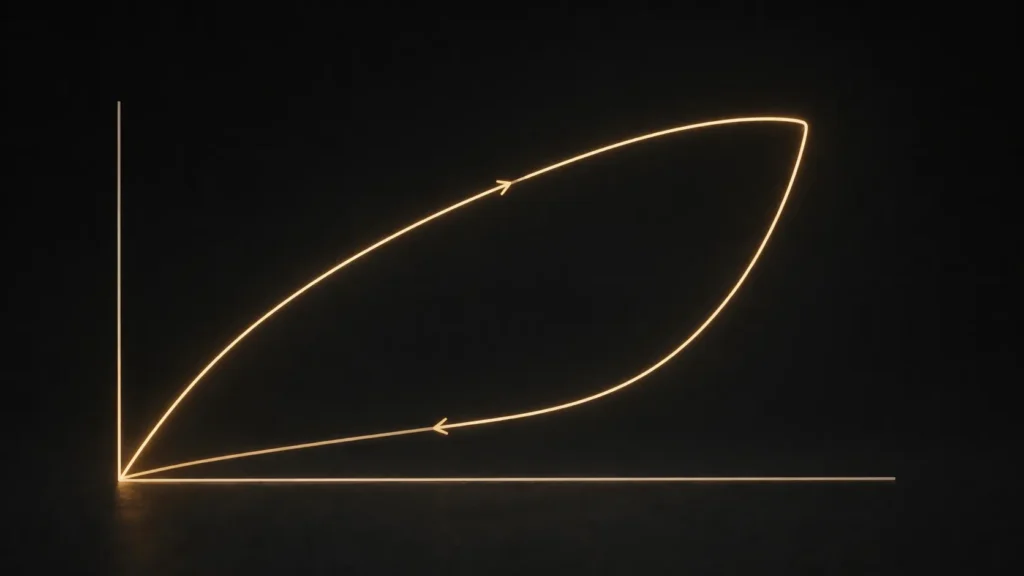
Forward and back, but not the same way.
🧠 UX Interpretation: History shapes the present
The hysteresis loop shows a system where the path forward differs from the path back. The output depends not just on the current input, but on what has already happened.
The shape is a loop, but not a circle. It widens, separates, and reconnects.
The system carries memory.
What once changed cannot be undone by simply reversing the input.
🎯 Theme: Irreversibility within systems
This model challenges the idea of clean reversal. It shows that change can leave traces.
Magnetism, climate, habits, markets. All can exhibit hysteresis.
The curve suggests that recovery takes a different path, often with greater effort.
It simplifies, yet introduces tension. The system resists returning to its previous state.
It works by showing that time matters.
💡 UX Takeaways
- Systems can retain memory of past states.
- Reversing input does not guarantee reversing outcome.
- Change can create lasting effects.
- Paths matter as much as positions.
- Models can reveal asymmetry in behaviour.
📎 Footnote
Hysteresis is used in physics, economics, and systems theory to describe processes where the relationship between input and output depends on the system’s history, often represented as a loop with different forward and backward paths.